

Celebrity smile discussions usually start from aesthetics but when the conversation turns to Doja Cat Teeth there is a deeper cultural sub-layer. Her smile is not only a visual element it became an internet “symbol” that maps fame, digital self-presentation, self-editing, and contemporary dental aesthetics. This makes the topic interesting not only for pop culture fans but also for people who want to understand how public-facing dentistry signals identity. This is why analysing Doja Cat Teeth is not just a “before and after look” it is a window into how a modern performer uses dental aesthetics as part of creative language.
DentRoute as an international dental brand is not trying to claim exactly which procedures she had. Nobody outside her clinical circle can state that with scientific certainty. Instead, what we can observe is how the visible surface of her smile evolved across time, and how those visible changes shaped user perception. And because our clinic works in cosmetic case analysis daily, we can contextualise those visual changes inside broader scientific frameworks enamel optics, shape theory, and perceptual symmetry categories.
What Will You Read?
What makes the evolution of Doja Cat Teeth an unusual case?
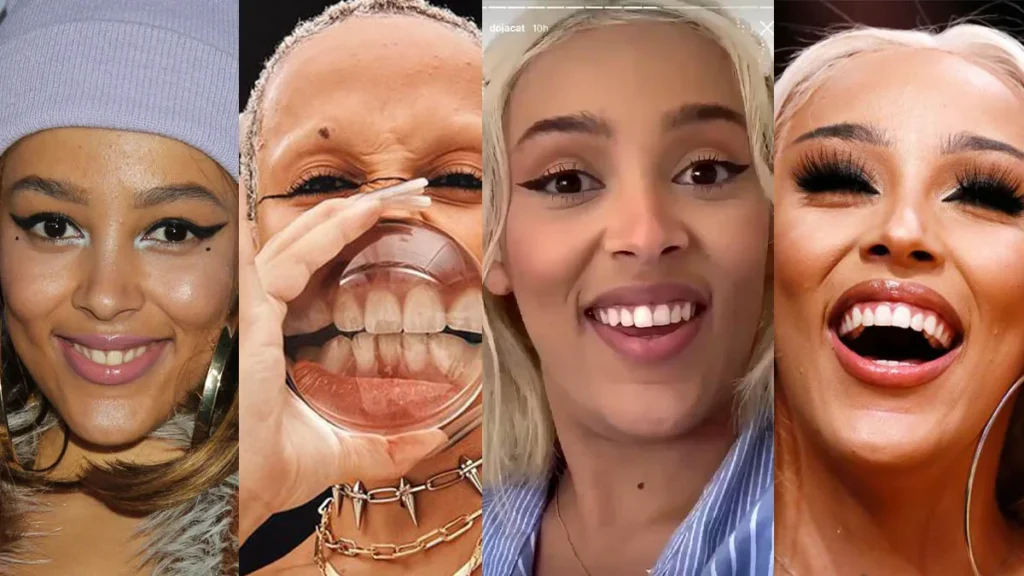
This is not a normal “celebrity veneers” topic. Doja Cat is one of the few major figures who shows radically different “smile identities” depending on video, era and outfit. The mouth becomes part of a costume an interface where humour, surrealism and aesthetic exaggeration can be “worn” on purpose.
Therefore when analysts look at Doja Cat Teeth the conversation is not linear. She does not simply “move from natural teeth → veneers” the same way many mainstream pop stars do. She occasionally shows worn shapes, vampire-style sculpting, exaggerated facial expression, or temporary conceptual shapes that do not follow classical rules of proportion.
This makes her an almost experimental reference figure.
Most blogs online treat this topic as clickbait but the real value here… is cultural behaviour mapping. A smile can be a costume not a fixed final architecture. That is new.
How the “before” state of Doja Cat’s smile is represented online
When early-era uploads circulate on social platforms (pre-major label era appearance), we see:
- shorter visible central incisor ratio
- less surface reflectivity
- unpolished edge line geometry
- colour temperature closer to natural dentin-dominant yellows rather than camera-white balance
DentRoute often analyses these attributes via perceptual categories, not “good/bad labels.” Because teeth are not binary objects they are material surfaces with optical behaviours. The internet usually ignores this.
The “before” versions of Doja Cat Teeth appear more relatable because they communicate authenticity. There is a sociological principle here: imperfection signals closeness. This is why fans often emotionally prefer early-era smiles they feel unscripted.
It is also interesting that Doja Cat never ran away from those images she embraces the evolution narrative. That alone differentiates her from many pop icons who aggressively hide the past.
How the “after” state is represented in public
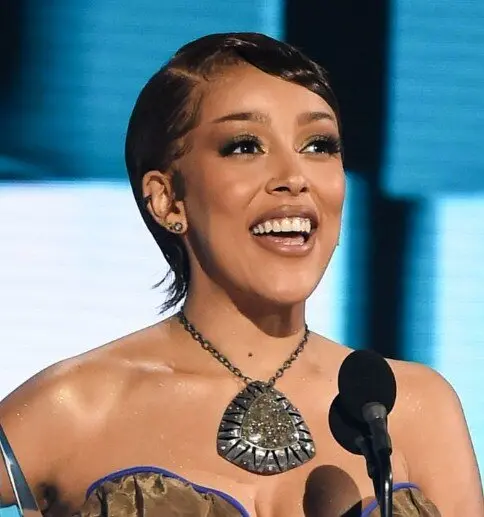
When she appears in most recent public award shows, music videos and fashion campaigns, the smile behaviour changes. What stands out:
- more controlled surface gloss (usually associated with post-production or high-polish ceramic)
- more defined central incisor silhouette
- more symmetry in midline dominance
- colour temperature reading as slightly colder white distance
But the result is not “the classic LA veneer archetype.” Her look does not try to mimic the typical “perfect model veneer” aesthetic.
Instead the smile looks concept-dependent.
Sometimes ultra bright. Sometimes intentionally monstrous. Sometimes naturalistic. Sometimes stylised like animation.
This variability implies a relationship with teeth that is performative not static.
And this is what makes Doja Cat Teeth such a powerful research direction. She uses her smile as a storytelling instrument not a fixed anatomical identity.
How Doja Cat Teeth aesthetics interact with facial proportions
Teeth do not exist visually as “isolated white objects.” They live inside a proportion system lip-line geometry, chin contour, nasal projection, and midface width all contribute to how dental shapes are interpreted. Many low-quality celebrity blogs ignore this. But any high-level analysis of Doja Cat Teeth must consider proportion mapping because she plays with proportion almost like a visual designer.
In multiple performances she exaggerates angles, jaw posture, lip tension, or smile amplitude. That single behaviour modifies how tooth length “reads.” For example even without any prosthetic a lip hold can make teeth look 1 mm longer or shorter in static photos. So when comparing eras the safest pattern is: evaluate full face ratios, not only the tooth surface.
This is also why she appears to “shift” from edgy, irregular, urban texture into smooth, iconic, hyper-clean white smile in press events. The anatomy may not be changing. The facial frame is changing.
And DentRoute’s dentists who study optical dentistry know: perception is 50% tooth anatomy + 50% face composition.
Chromatic shifts observed in the evolution of Doja Cat Teeth
Most people think whiteness is “one simple slider.” Reality is more complex. Colour accuracy depends on:
- camera white balance targets
- sensor dynamic range
- makeup reflectance
- lateral light spillover from stage side lighting
When early era images show warmer chroma the instinctive conclusion online is “she had whitening later.” Maybe. Or maybe the cameras were not optimised for cold-white profiles yet.
This is the problem with celebrity dental deduction online: optical environments can fake dental transformation narratives.
Still there is a consistent trend in her most recent images colder high-value white. This colder white is consistent with popular ceramic veneer optics found in the last seven years. Many high-end ceramic systems today are engineered for cooler hue to match HD camera norms.
That does not mean she has veneers. That simply means the current aesthetic language of her public image prioritises an HD-friendly optical white.
So analysing Doja Cat Teeth cannot be purely biological it must be optical.
Why younger users obsess so much over influencer white points
There is a behavioural data pattern in social media analysis: when a young female celebrity changes tooth colour gradation younger users replicate those white points in selfie edits. The white RGB mapping becomes a trend element like contouring.
Doja Cat because she shapeshifts triggers multiple white point archetypes.
Example pattern observed online (approximate trend roles):
| Era / aesthetic gesture | White temperature perception |
| Early YouTube era vibe | warm neutral yellowish white |
| First Billboard era breakthrough | semi-cool studio white |
| High-fashion / Met Gala seasons | hyper-cool bright white |
| Conceptual costume eras | surreal non-human white |
This alone makes Doja Cat Teeth more research-worthy than classic pop vocalists her teeth are not merely “teeth” they are instruments of visual punctuation.
The smile is re-skinned like a UI element.
And this is culturally new.
Why the evolution of Doja Cat Teeth can be interpreted as visual language not “treatment result only”
Certain performers use hair, nails, eyebrows, teeth as semiotic markers. Meaning: these body surfaces become typography. Doja Cat is one of the clearest examples of this. Her smile is not simply a dental structure it is a symbol switchboard she activates based on artistic need.
This is why Doja Cat Teeth analysis if done responsibly cannot be reduced to “she got veneers.” That narrative is too shallow. The artistic context has more predictive power than the clinical speculation.
Her “demonic,” “cartoon-like,” or “satirical glam” phases all show different edge morphology, different reflectance strategy, different chromatic targets and this is what fascinates culture analysts. Each period maps to an emotional register.
The mouth becomes a canvas.
Final reflection on the “before and after” model around Doja Cat Teeth
In classical celebrity blogs, “before and after” means “bad → good.”
That binary is outdated.
Doja Cat kills that binary.
“Before” is authenticity.
“After” is visual performance.
Both are valid identities, not a moral ladder.
The reason researching Doja Cat Teeth became important in dental discourse is because it shows the new role of the smile in the digital era:
- not a final destination
- but a dynamic UI-coded expression
- flexible, modular, mood-dependent
Her evolution is an argument against all simplistic dental beauty rules.
If someone wants the cultural takeaway:
Doja Cat proved that teeth can be narrative devices not static anatomical furniture.
The transformation of Doja Cat Teeth is not just a cosmetic timeline it is an artistic interface. Her smile interacts with camera optics, algorithmic virality, colour psychology, facial proportion mathematics and creative moodboarding. You can look at it as performance art in miniature form every millimetre becomes storytelling surface.
And this for a scientifically curious clinic like DentRoute is the real intellectual value here.
It teaches the industry that the future of celebrity dentistry may not be “one ideal smile for life.”
It may be like Doja Cat multiform, modular, context-tuned, and ever-evolving.
That is why this topic deserves long-form, research-level writing not gossip-level speculation.

 Dijital Performans Ajansı.